
In the construction industry, designing a structural fastening system means ensuring that each component can maintain safety and performance over time under real service conditions.
Every structural connection — from fastening steel structures to concrete anchoring systems — represents a critical point within the entire construction system. An error in this design phase can compromise both the durability of the structure and the safety of people.
For this reason, designers and engineers must clearly distinguish between mean ultimate load, characteristic load, design load, and allowable resistance. These concepts play very different roles within the verification process.
Understanding this distinction is also essential for correctly navigating between the traditional allowable stress design method and the more advanced limit state design method, which is now the primary reference according to Eurocodes and current technical standards.
The transition from a design approach based on global safety factors to one based on partial safety factors has profoundly changed the way structural anchors are designed. Today, verification is no longer based solely on a generic safety margin, but on a more precise analysis of actions, resistances, and uncertainties associated with each parameter.
In this article, we clearly explain the differences between these values, how to interpret them correctly, and the role they play in structural fastening design. This is an essential step for performing reliable calculations, compliant with ETA certifications and aligned with current regulatory requirements.
Limit State Design Method
The Limit State Design (LSD) method represents the modern approach to structural design, where safety is evaluated using separate partial safety factors for loads and resistances. This makes it possible to isolate uncertainties and achieve a more accurate estimate of the real structural behavior.
ULS: Ultimate Limit States define the conditions under which the structural safety is compromised.
The partial safety factors applied to loads and resistances ensure that the structure can withstand the applied actions without collapse.
SLS: Serviceability Limit States define the conditions in which the structure remains safe, but its functionality may be reduced.
Partial safety factors allow a targeted evaluation of structural behavior by separating actions and resistances, ensuring service performance throughout the design life.
Traditional Allowable Stress Method
The traditional design method evaluated safety using a single global safety factor that reduced the material resistance.
All uncertainties — loads, materials, and construction conditions — were considered together, without distinguishing between different sources of risk.
Safety was considered verified if the calculated stresses remained below the allowable reduced stress.
However, this approach did not accurately reflect the real behavior of materials beyond the elastic range and was less precise than the limit state method.
Mean Ultimate Load
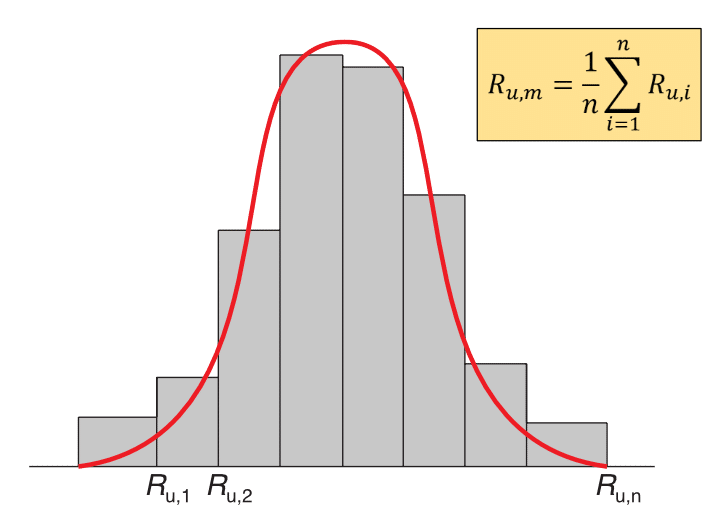
The mean ultimate load (Ru,m) is the average resistance value of the anchor, determined experimentally by testing multiple samples to failure.
It is calculated by summing all measured ultimate values and dividing by the total number of tests.
The measured values tend to be distributed around the mean according to a Gaussian distribution (bell curve), where only a few samples show very low or very high resistance values, while most of them are concentrated near the average.
The mean ultimate load describes the actual behavior of the system. However, even knowing Ru,m, it cannot be directly used for design purposes because it does not account for data dispersion: some samples may fail at values lower than the average.
Characteristic Load
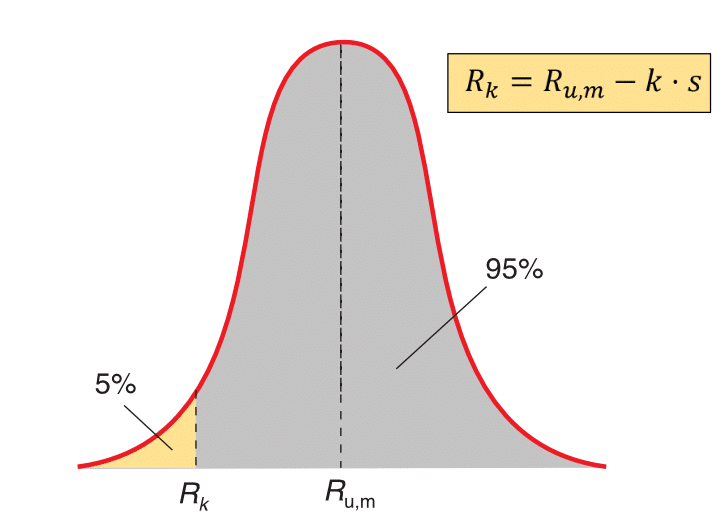
The characteristic value (Rk) represents a conservative estimate of the anchor resistance, taking into account its statistical variability.
It is generally defined as the lower fractile of the distribution, meaning the value below which only a small percentage (typically 5%) of laboratory test results are expected to fall.
In the formula:
Ru,m represents the average value of measured resistances
s is the standard deviation, indicating how much the values deviate from the mean
k is a statistical coefficient related to the selected fractile, used to determine how far the characteristic value must be from the average to ensure a prudent safety margin
The characteristic value of the anchor is reported in the product’s ETA (European Technical Assessment).
Design Load
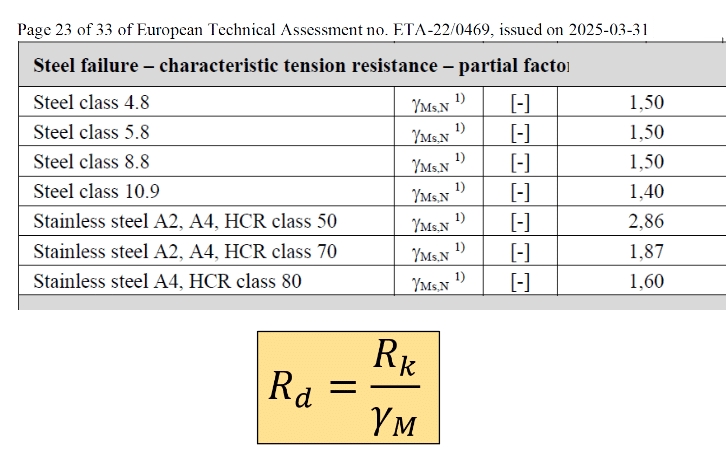
The design resistance (Rd) of an anchor is obtained by applying the material-side partial safety factor γM to the characteristic value Rk.
This factor accounts for possible uncertainties related to material properties, such as: test variability, manufacturing defects, actual working conditions on site.
These coefficients are defined in the Eurocodes.
For products with ETA certification, γM values are often also reported in Annex C of the technical documentation, together with characteristic resistances and declared performances.
In the Ultimate Limit State (ULS) calculation, the design action is directly compared with the design resistance:
The verification consists of ensuring that the design actions Ed never exceed the structural capacity Rd.
Allowable Resistance
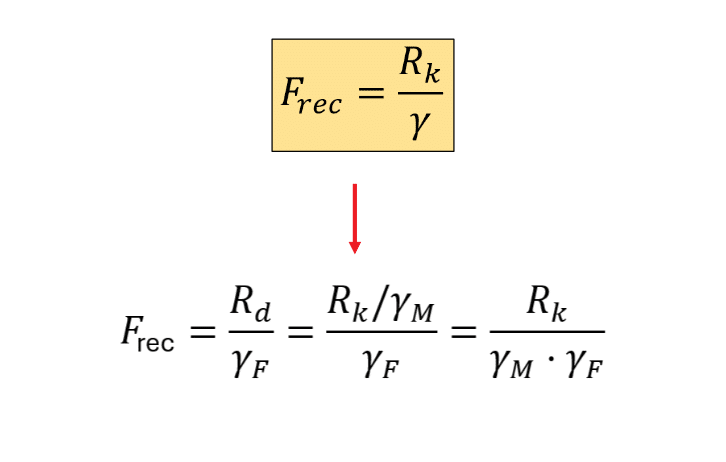
The recommended load (Frec) represents the effective anchor resistance to be compared with actual service loads in order to guarantee safety and proper performance.
Starting from the characteristic value, Frec can be obtained
- by dividing the characteristic value by a global safety factor γ
- or, using the partial safety factor method, by first calculating the design resistance and then determining Frec with γF = 1.4
The Serviceability Limit State (SLS) verification is performed by comparing the actual stress S with the recommended load:
If this condition is satisfied, the anchor is considered safe during service conditions.
Conclusion
Correct structural fastener design also depends on the ability to properly interpret resistance values and apply the most suitable verification method.
Understanding the difference between mean ultimate load, characteristic value, design resistance, and recommended load helps avoid common errors such as oversizing or, even worse, underestimating structural risk.
In the daily work of designers and engineers, the real goal is to ensure that the entire anchoring system performs correctly under actual installation conditions and complies with current technical regulations.
Need a design tool?
Download our dedicated structural fastening calculation software: a solution developed to support designers and professionals in the fast and reliable determination of anchor resistances and limit state verifications.
An updated and practical tool designed to simplify the daily work of those who need to design structural fixings quickly, safely, and in full compliance with current standards.